

If you’re working in environmental compliance today, you probably already feel it. Things are getting stricter, faster, and more complex.
It’s no longer enough to just “manage” waste or operate treatment systems. Environmental practitioners in 2026 are expected to think ahead, optimize processes, and even leverage new technologies like Artificial Intelligence (AI). With the Department of Environment (DOE) enforcement tightening and sustainability becoming a business priority (not just a compliance checkbox), upskilling is quickly becoming a necessity.
Here are five EIMAS courses that are not just relevant, but genuinely worth your time this year.
Cutting Costs with Sustainable Solutions: Elimination, Prevention, and Circular Economy in Waste Minimization
Most organizations still manage waste reactively handling it only after it is generated.
This course challenges that mindset by focusing on prevention. It explores how waste can be reduced at the source through better processes, material selection, and operational practices. It also introduces circular economy concepts, where waste is reused, recycled, or repurposed rather than disposed.
Key areas include legal requirements under EQA 1974, scheduled waste classification, and practical waste minimization techniques such as solvent recovery and material reuse.
With increasing disposal costs and stricter environmental expectations, companies that prioritize prevention over treatment will always have an advantage. For practitioners, this is a shift from routine compliance to strategic environmental management.
Optimizing Scheduled Waste Management: Unlocking Efficiency Through AI for Business Profit
AI is no longer a future concept, it is already changing how work gets done.
This course introduces how tools like ChatGPT can support scheduled waste management, from improving documentation to enhancing compliance processes. Participants learn how to structure prompts, generate reports, and apply AI to tasks such as waste inventory tracking and EPMC reporting.
Key modules include AI fundamentals, prompt structuring, waste documentation, and AI-assisted waste minimization strategies.
As environmental work becomes more data-driven and documentation-heavy, the ability to work efficiently is critical. Practitioners who adopt AI early will be better equipped to handle complex reporting requirements and reduce operational inefficiencies.
Effective IETS Management with Membrane Filtration and AOP: : Reducing Effluent Costs and Minimizing Business Loss
Wastewater compliance is becoming increasingly demanding, and conventional approaches are no longer sufficient.
This course focuses on advanced treatment technologies such as membrane filtration (RO, UF, NF) and Advanced Oxidation Processes (AOP), helping practitioners understand how to select and manage effective treatment systems.
Key modules include industrial effluent characteristics, treatment technologies, system troubleshooting, and performance monitoring.
Under the Environmental Quality (Industrial Effluent) Regulations 2009, failure to meet discharge standards can result in serious consequences. This training equips practitioners with the technical knowledge needed to maintain compliance while improving system efficiency and reducing risks.
Enhancing Wastewater Treatment Using MBR Technology for Environmental and Business Profit
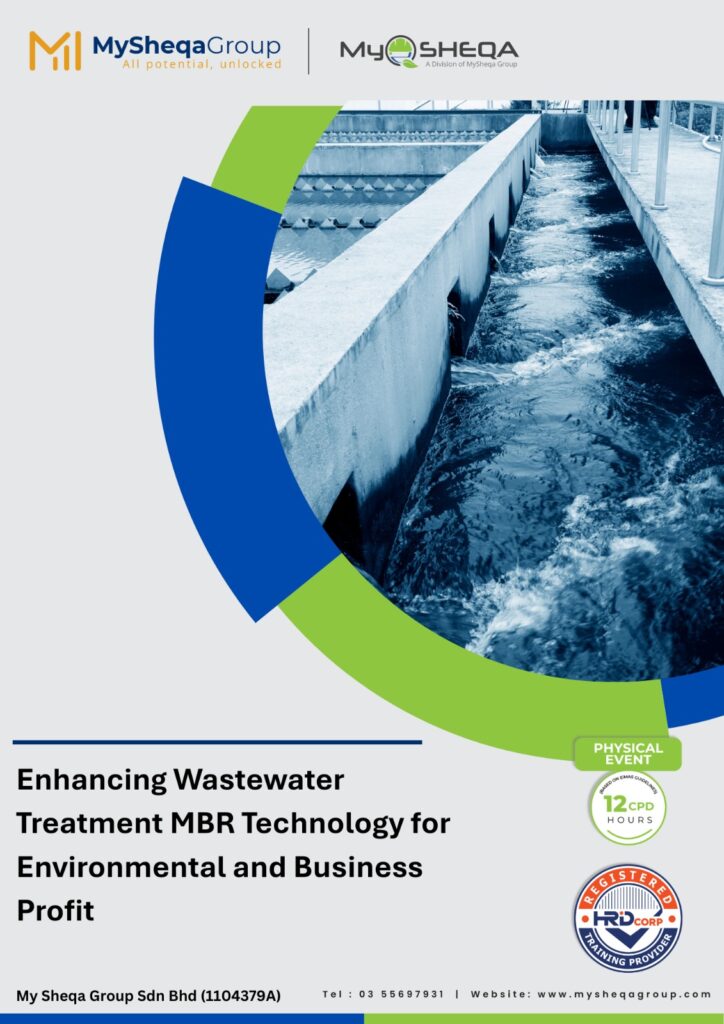
Membrane Bioreactor (MBR) technology is gaining traction as industries move toward more efficient wastewater treatment solutions.
This course introduces the principles of MBR-UF systems, compares them with conventional activated sludge systems, and explores how to optimize system performance.
Key modules include MBR design analysis, biological treatment processes, system comparison, and performance improvement strategies.
As discharge standards become stricter, industries are turning to advanced technologies to ensure compliance. Practitioners who understand these systems will be better positioned to manage performance, reduce costs, and support long-term environmental goals.
Optimizing APCS Efficiency: Bag Filter Design and Operation for Improved Business Performance
Air emissions are often overlooked, until they become a problem.
This course focuses on Air Pollution Control Systems (APCS), specifically bag filter systems, which are critical for controlling particulate emissions and ensuring compliance with the Environmental Quality (Clean Air) Regulations 2014.
Participants will learn how APCS systems function, how bag filters are designed, and how to monitor and maintain performance effectively. The course also covers troubleshooting common issues such as filter failures, system inefficiencies, and airflow problems.
In today’s regulatory environment, poor air emission control can lead to serious compliance breaches and environmental impact. Practitioners who understand APCS design and operation will be better equipped to prevent failures, maintain system efficiency, and ensure consistent compliance.
Conclusion
Environmental roles are becoming more technical, strategic, and increasingly shaped by evolving regulations and industry expectations. Practitioners today are not only expected to ensure compliance, but also to contribute to efficiency, performance, and long-term sustainability within their organizations.
As the landscape continues to evolve, keeping knowledge and skills up to date becomes part of the role itself. Whether it’s understanding new treatment technologies, improving waste practices, or adapting to digital tools, staying current helps practitioners navigate challenges more confidently.
In many cases, the difference lies not in doing more, but in doing things better, with the right understanding, the right approach, and the right exposure over time.