
The HSE Practitioner of 2030: What Skills Will Matter Most?
Picture an HSE practitioner arriving at work in 2030. Before the first site walk begins, a dashboard has already flagged an unusual pattern in near-miss reports. A wearable device has identified rising heat-stress exposure, while an AI tool has summarised hundreds of inspection records. Management wants an answer before the morning meeting: What is happening, what could go wrong and what should the organisation do next?
The technology may be impressive, but it does not make the decision. Someone must check whether the information is reliable, understand the real conditions on the ground, speak with workers and recommend controls that are practical, ethical and legally sound. That person is still the HSE practitioner, but the job is becoming broader.
This shift is not limited to safety and health. The World Economic Forum identifies AI and big data, technological literacy, environmental stewardship, analytical thinking, leadership and lifelong learning among the skills expected to increase in importance toward 2030 (World Economic Forum, Future of Jobs Report 2025). For HSE professionals, the message is clear: technical competence remains essential, but it will increasingly need to work alongside digital, strategic and people-centred capabilities.
HSE practitioners skills have to expand not just linearly, but across the board.
Will Traditional HSE Knowledge Still Matter?
Absolutely.
A practitioner who cannot recognize hazards, evaluate risk, understand legal duties or select suitable controls will not become more competent simply by using advanced software. The fundamentals remain the foundation: hazard identification, risk assessment, occupational health, incident investigation, emergency preparedness, worker consultation and control of operational risks.
Traditional HSE knowledge remains important even as workplaces adopt new technologies. ISO 45001 is an international standard that helps organisations manage workplace safety and health systematically. It emphasises leadership, worker involvement, hazard identification, risk assessment, legal compliance and continuous improvement (ISO, ISO 45001 overview).
These fundamentals are not outdated. They give HSE practitioners a reliable foundation for assessing whether new information and technologies will genuinely improve workplace safety.
Think of future-ready skills as an additional layer, not a replacement. By 2030, employers may expect an HSE practitioner to recognise a confined-space hazard and also interpret exposure trends; investigate an incident and also question the quality of the data; understand legislation and also explain safety implications to senior management in business terms.

The Most Important HSE Practitioner Skills for 2030
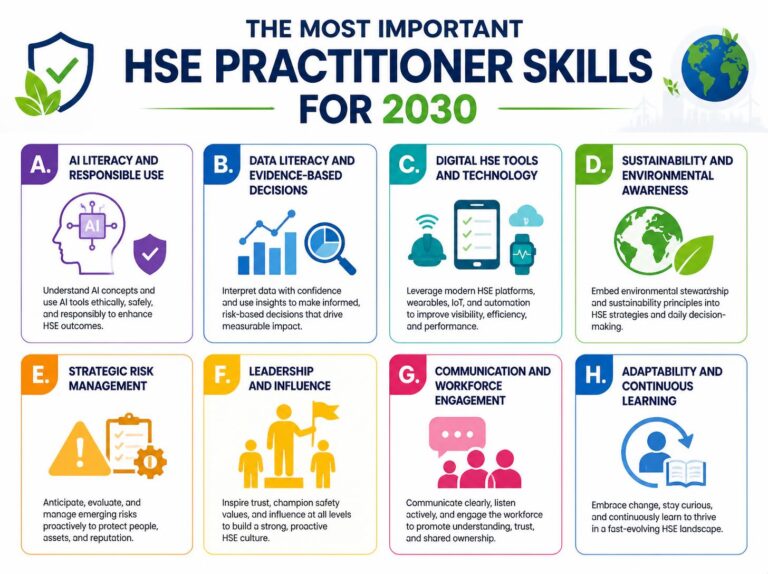
A. AI Literacy and Responsible Use
You do not need to become a software engineer. You do, however, need enough AI literacy to understand what a tool can do, where its answers come from and when its output should not be trusted. AI may help organise observations, detect patterns, draft training material or summarise records. It must not be treated as an unquestionable safety authority.
A capable practitioner will verify AI-generated information against legislation, technical standards and actual workplace conditions. They will also recognise privacy, confidentiality, bias and accountability concerns. If an algorithm recommends a control that fails, responsibility cannot simply be handed to the software.
The International Labour Organization reports that AI, automation and smart monitoring can reduce hazardous exposure and support safer work, while also creating new risks that require proactive and participatory responses (ILO, Revolutionizing Health and Safety: The Role of AI and Digitalization at Work). The practical skill, therefore, is not merely knowing how to use AI. It is knowing how to use it responsibly.
B. Data Literacy and Evidence-Based Decisions
Many organisations already collect incident numbers, inspection findings, training records and exposure-monitoring results. The real challenge is turning those records into insight. By 2030, HSE data literacy may separate practitioners who simply report performance from those who can improve it.
This means understanding trends, rates, leading and lagging indicators, data quality and basic visualisation. It also means asking better questions. Is an apparent fall in incidents evidence of safer work, or a sign of under-reporting? Are repeated near misses concentrated in one task, shift or contractor group? What decision should follow from the pattern?
You do not need to become a statistician. Start by becoming comfortable with spreadsheets, dashboards and clear charts, then learn how to explain what the numbers do (and do not) prove.
C. Digital HSE Tools and Technology
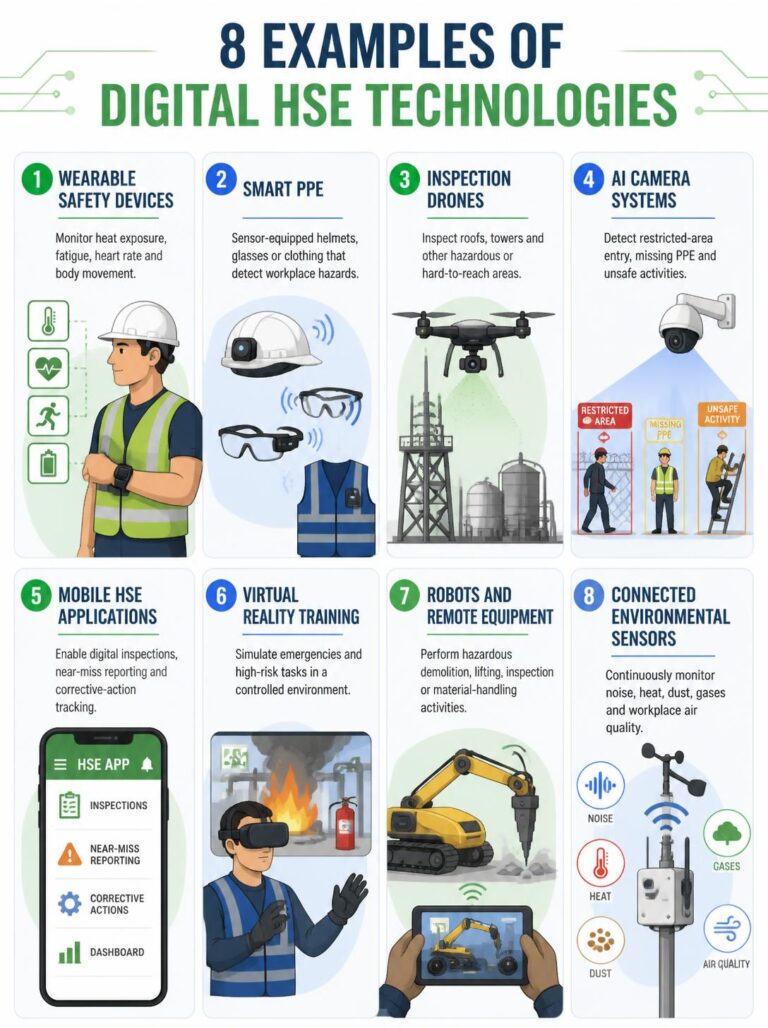
Digital inspections, mobile reporting, sensors, connected equipment, drones, wearables and virtual training are becoming part of the HSE landscape. Malaysia’s Occupational Safety and Health Master Plan 2021–2025 included a strategic thrust on strengthening OSH through technology, including smart workplaces, a technology ecosystem and digital management of OSH risks.
DOSH has publicly described these technology-focused programmes as important to creating safer and more efficient workplaces (DOSH Malaysia). The 2030 practitioner should therefore be able to evaluate a digital tool based on the risk it addresses, the reliability of its information and how well it fits real work—not simply because it is new.
Basic cybersecurity awareness will matter too. Inspection records, health information and incident evidence can be sensitive. A convenient digital system is not a good HSE system if access, accuracy and confidentiality are poorly controlled.
D. Sustainability and Environmental Awareness
The boundaries between occupational safety, environmental management and business sustainability are becoming harder to ignore. Heat stress, extreme weather, energy transition, new materials, waste processes and changing technologies can create both environmental and worker-safety implications.
An HSE practitioner does not need to perform every environmental specialist’s role. However, understanding environmental aspects, pollution prevention, resource efficiency and climate-related workplace risks will help practitioners recognise connected problems. A process change that reduces emissions, for example, must still be assessed for chemical exposure, maintenance and emergency risks.
Malaysia is also placing greater attention on green workforce capabilities. TalentCorp has described renewable energy, sustainable design, energy efficiency and waste management as skills relevant to the region’s green transition (TalentCorp, ASEAN Green Skills Fair 2025). For HSE professionals, environmental awareness will increasingly support more complete risk decisions.
E. Strategic Risk Management

A technically correct recommendation is useful only if people understand it, support it and act on it. Future HSE leadership will be less about policing every rule and more about influencing supervisors, managers, designers, contractors and workers to make safer decisions.
That requires confidence without arrogance. Practitioners must know when to challenge, when to listen and how to translate risk into language different audiences understand. A production manager may need to hear the operational consequence. A worker may need a straightforward explanation of how the control affects the task. Senior leaders may need a clear choice, supported by evidence and accountability.
F. Leadership and Influence
Compliance asks, “Are we meeting the requirement?” Strategic risk management asks a second question: “What could materially harm our people, operations and future, and how do we prevent it?” The HSE practitioner of 2030 will need to connect workplace risk with business continuity, procurement, project design, contractor management, reputation and organisational resilience.
This involves looking upstream. Instead of waiting for a machine to be installed before assessing its hazards, practitioners should contribute during design and purchasing. Instead of treating contractor incidents as somebody else’s problem, they should examine how commercial decisions, schedules and supervision affect risk.
For example, before purchasing a new machine, an HSE practitioner can review its guarding, noise level, maintenance access and emergency-stop features with the engineering and procurement teams. Identifying these concerns before the purchase allows safer specifications to be included in the order, avoiding costly modifications and unnecessary risks after installation.
The earlier HSE enters a decision, the greater the opportunity to eliminate hazards rather than manage their consequences.
G. Communication and Workforce Engagement
Good communication is not about producing longer presentations, detailed reports or complicated safety messages. It is about explaining important information clearly enough for people to understand the risk and take the right action. By 2030, HSE practitioners may communicate with employees from different generations, cultures and levels of technical knowledge, as well as contractors, platform workers and remote teams. They must therefore know when to use a formal report, visual guide, toolbox talk, digital alert or simple face-to-face conversation.
Communication must also be a two-way process. Workers are often closest to the task and may identify hazards that do not appear in procedures, inspection forms or incident statistics. By listening to their concerns and experiences, HSE practitioners can better understand why unsafe situations occur instead of immediately assuming that workers are careless or unwilling to follow instructions.
Worker engagement becomes even more important when technology is involved. A sensor may detect an exposure, but workers can explain what was happening at the time. A dashboard may reveal a trend, while a conversation could uncover production pressure, fatigue, equipment problems or a control that appears effective on paper but fails during the actual task. Technology can indicate where to investigate, but human insight provides the context needed to make better safety decisions.

H. Adaptability and Continuous Learning
The regulations, hazards and tools you know today will not cover every workplace challenge in 2030. New energy systems, automation, changing work arrangements and emerging psychosocial risks will keep testing the profession. The most durable skill may therefore be the ability to keep learning.
Continuous learning does not mean collecting certificates without a clear purpose. It begins with identifying genuine gaps in knowledge and selecting credible training that supports a practitioner’s current responsibilities or future career direction. Depending on their needs, practitioners may explore programmes offered by DOSH-registered training providers in areas such as OSH Coordinator, safety and health management, chemical safety, hazard identification and risk assessment, ergonomics, machinery safety, working at height, confined-space safety and emergency preparedness.
The right course should offer more than a certificate. Practitioners should consider whether the programme is relevant to their work, delivered by qualified trainers and supported by practical activities or industry examples. They should also distinguish between general professional-development courses and formal competency programmes that may involve specific eligibility, assessment or registration requirements.
Training is only valuable when the knowledge is applied. After attending a programme, practitioners should look for opportunities to improve inspections, strengthen risk assessments, communicate more effectively or introduce better controls at work. Curiosity becomes professionally valuable when it leads to stronger competence, better questions and safer decisions.
Will AI Replace HSE Practitioners?
AI is more likely to change parts of the job than remove the need for the profession. Routine drafting, classification and pattern detection may become faster. Site judgement, worker consultation, ethical decisions, legal accountability and leadership are much harder to automate responsibly.
The greater risk is not that every practitioner will be replaced by AI. It is that practitioners who refuse to understand new tools may become less effective than colleagues who can combine them with solid HSE judgement. The reverse is also true: a person who knows the software but lacks safety fundamentals can produce polished, and dangerous, answers.
From Compliance Officer to Strategic Adviser
The strongest HSE professionals of 2030 will continue to ensure legal compliance, but their contribution will extend beyond checking whether requirements have been met. They will help management understand how workforce health, operational pressures, environmental changes and emerging technologies can affect safety, productivity and business continuity. Instead of waiting for an incident to reveal a weakness, they will use workplace observations, risk data and employee feedback to identify concerns early and recommend practical action.
Strategic influence does not require every HSE practitioner to have a seat in the boardroom. It can begin during a toolbox meeting, equipment-purchasing discussion, contractor briefing or project review. For example, a practitioner who identifies safety concerns before new machinery is purchased can help prevent costly modifications later. Each time an HSE professional connects a workplace hazard to the decision that created it, and proposes a realistic solution, they move beyond enforcing rules and become a trusted adviser to the organisation.
How HSE Practitioners Can Prepare for 2030
You do not need to master everything at once. Start with a practical development plan:
- Strengthen your HSE fundamentals and keep current with applicable Malaysian legislation and guidance.
- Learn one data tool well enough to clean information, identify trends and present a clear conclusion.
- Experiment with AI on low-risk tasks, then verify every important output and protect confidential information.
- Build environmental and sustainability awareness relevant to your industry.
- Join project, procurement or operational discussions to understand how risk is created upstream.
- Practise explaining the same risk to workers, supervisors and senior management in language each group can use.
- Choose training based on a real competency gap, not merely the popularity of a topic.
A useful personal question is: If my routine reporting became automated tomorrow, what higher-value judgement could I contribute? Your answer points toward the skills worth developing now.
The Future Still Needs Human Judgement
The HSE practitioner of 2030 will not be defined by one application, certificate or job title. The profession will need people who can combine regulatory and technical knowledge with AI literacy, data interpretation, environmental awareness, strategic thinking and human leadership.
Technology can help practitioners see more, process information faster and intervene earlier. It cannot care whether a worker returns home safely, understand every workplace reality or carry professional responsibility on its own.
The future of HSE is therefore not human versus machine. It is about capable practitioners using better tools without surrendering judgement.
For anyone building an HSE career today, that should be encouraging. You do not need to predict every technology that will appear by 2030. Build strong foundations, remain curious and learn to turn information into action. Those abilities will travel with you, regardless of how the tools change.