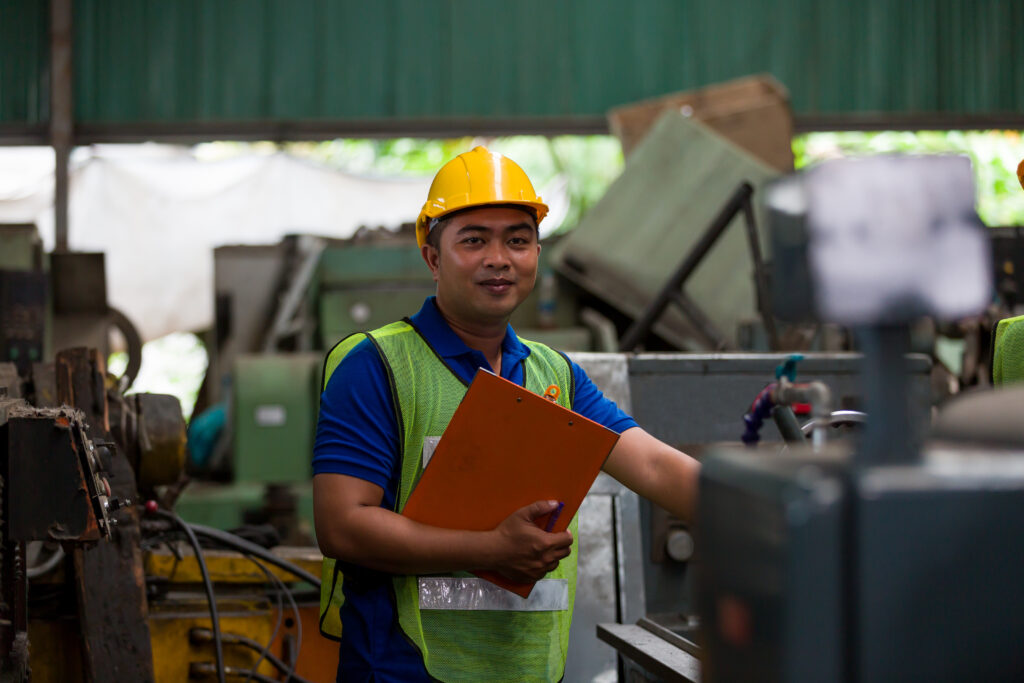
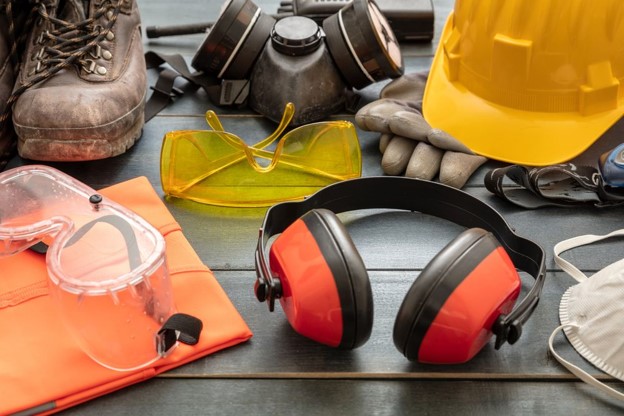
Safety helmets, gloves, safety shoes and reflective vests are common sights in factories, construction sites, workshops and warehouses. Their presence creates an immediate impression that employees are protected and workplace safety requirements are being followed. Yet accidents continue to happen even when employees are wearing personal protective equipment.
Workers wearing gloves still suffer hand injuries. Employees using respirators may still inhale harmful substances. Safety harness users can still be seriously injured during a fall. A helmet may reduce the severity of an injury, but it cannot prevent an object from falling.
The problem is not that personal protective equipment is unimportant. PPE is an essential part of workplace safety when it is selected, fitted, maintained and used correctly. However, it does not normally remove the hazard itself.
Effective PPE workplace safety requires employers to look beyond visible compliance.
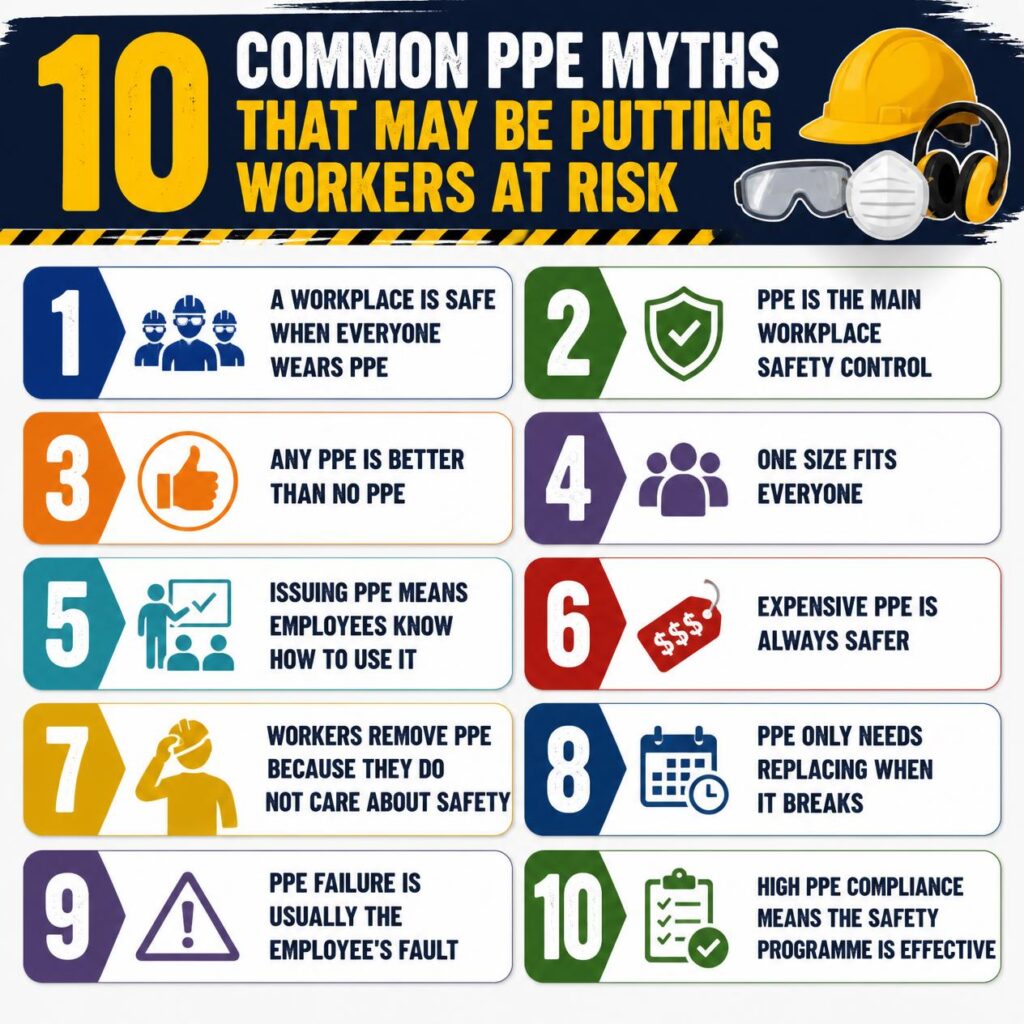
Here are 10 common PPE myths that may be putting workers at risk.
Myth 1: A Workplace Is Safe When Everyone Wears PPE
Reality: The hazard remains even when PPE is worn
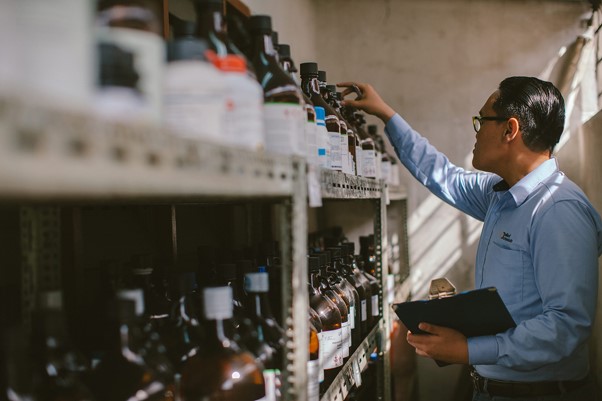
A safety helmet does not prevent materials from falling. Gloves do not stop machinery from moving. A respirator does not remove toxic contaminants from the air.
PPE works by creating a barrier between the employee and the hazard. If the barrier fails, is used incorrectly or is unsuitable for the exposure, the employee may still be injured.
Instead of asking only whether employees are wearing PPE, employers should ask whether the hazard can be eliminated, reduced or controlled before it reaches the employee. PPE should protect employees against the remaining risk after other reasonably practicable controls have been implemented.
Myth 2: PPE Is the Main Workplace Safety Control
Reality: PPE is the last line of defence
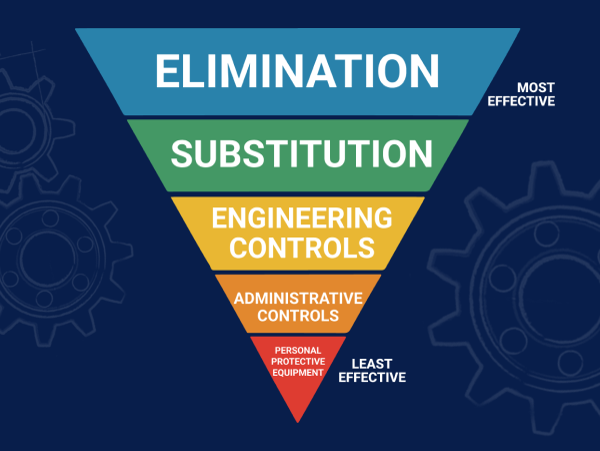
PPE is positioned at the lowest level of the hierarchy of controls. The preferred order for managing workplace risks is Elimination, Substitution, Engineering Controls, Administrative Controls, Personal Protective Equipment.
The DOSH Guidelines for Hazard Identification, Risk Assessment and Risk Control describe the hierarchy of controls as the established order of priority for controlling risks.
For example, earplugs may reduce the noise reaching an employee’s ears, but they do not reduce the noise produced by the machine. Enclosing the equipment, improving its maintenance or replacing it with a quieter alternative control the hazard more effectively.
Myth 3: Any PPE Is Better Than No PPE
Reality: The wrong PPE may provide little protection
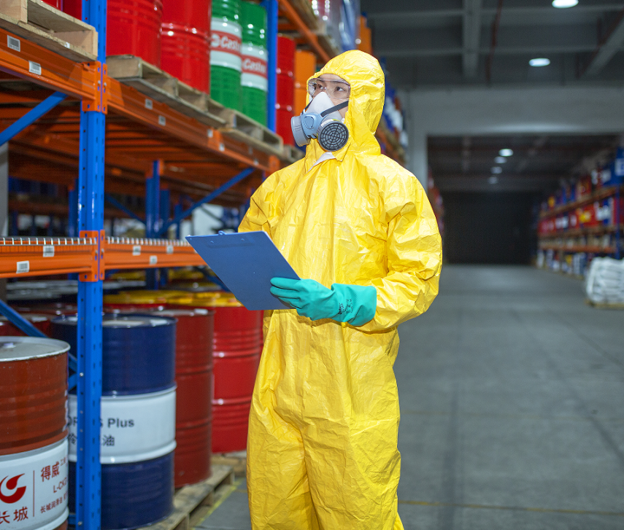
Not every glove protects against every chemical. Safety glasses may not provide sufficient protection against chemical splashes, while an ordinary disposable mask may not protect against toxic gases or vapours.
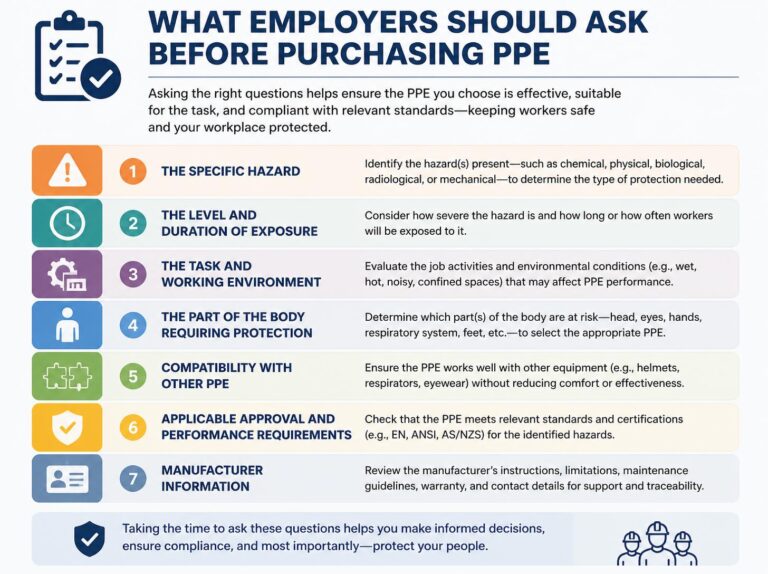
Choosing equipment mainly based on price, convenience or availability may give employees a false sense of security. The correct question is not simply, ‘Are gloves provided?’ It is, ‘Are these gloves suitable for this chemical, concentration, task and duration of use?’
Myth 4: One Size Fits Everyone
Reality: Poorly fitted PPE can fail during use
Employees have different body sizes, face shapes and physical characteristics. One size or model may not be suitable for every person.
Oversized gloves may reduce grip or become caught in moving equipment. Loose safety glasses can allow particles to enter from the sides. An incorrectly adjusted helmet may fall off when the employee bends forward.
Fit is particularly important for respiratory protective equipment. Tight-fitting respirators must form an effective seal against the face. Facial hair, incorrect strap adjustment, incompatible eyewear or an unsuitable facepiece can allow contaminated air to leak inside.
Employers should provide suitable sizes and models instead of expecting employees to adapt to whatever equipment is available.
Myth 5: Issuing PPE Means Employees Know How to Use It
Reality: Providing PPE Does Not Mean Employees Are Competent to Use It
Many organisations ask employees to sign a form when receiving PPE. The record confirms that the equipment was issued, but it does not prove that the employee knows how to use it correctly.
Training should include practical demonstrations and opportunities for employees to practise using the equipment. Supervisors should verify competency through observation during actual work. A signature on an issuance form cannot replace practical instruction
To ensure that PPE is used safely and effectively, training should cover the following essential areas:
- Why the PPE is required
- Which hazards it protects against
- Its limitations
- How to wear, adjust and inspect it
- How to remove it safely
- How to clean and store it
- When it should be replaced
- How to report defects or damage
Myth 6: Expensive PPE Is Always Safer
Reality: Suitability matters more than price
Premium PPE may offer improved comfort, durability or additional features. However, a higher price does not automatically make a product suitable for every hazard.
An expensive chemical-resistant glove can still fail if its material is incompatible with the chemical being handled. An advanced respirator will not provide adequate protection if the wrong cartridge is installed. A high-quality safety harness can still be dangerous if it is attached to an unsuitable anchor point or used without an effective rescue plan.
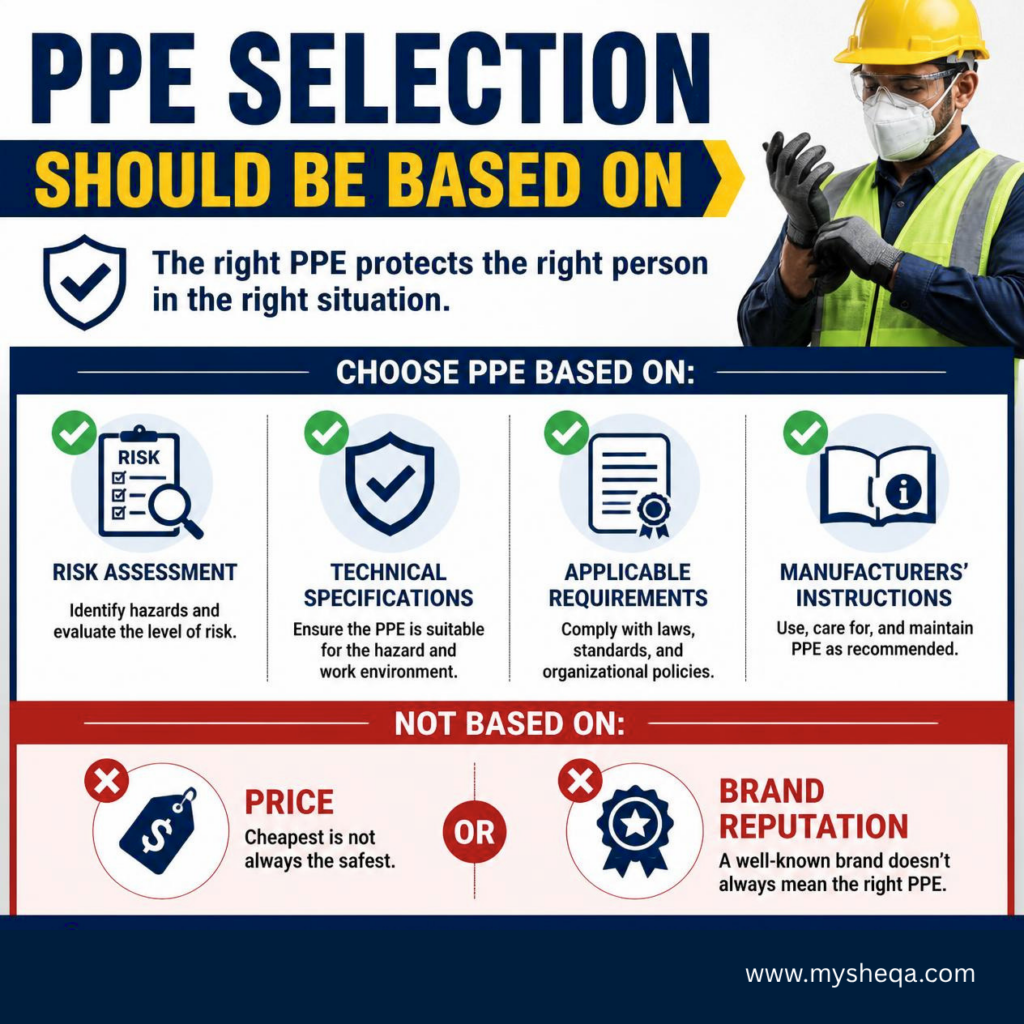
PPE selection should be based on risk assessment, technical specifications, applicable requirements and manufacturers’ instructions, not price or brand reputation alone.
Myth 7: Workers Remove PPE Because They Do Not Care About Safety
Reality: Non-compliance may reveal problems within the system
Some employees may deliberately disregard safety rules, but not every PPE violation is simply an attitude problem. Reasons why employees are taking off their PPE include:
- The equipment does not fit properly
- It causes excessive heat or discomfort
- Safety glasses repeatedly fog
- Gloves reduce grip or dexterity
- PPE interferes with communication
- Suitable replacements are unavailable
- Production pressure encourages shortcuts
- Rules are enforced inconsistently
- Training was inadequate
Malaysia’s hot and humid conditions can make some forms of protective clothing and respiratory equipment difficult to wear for extended periods. This does not justify unsafe behaviour, but it should be considered during PPE selection and work planning.
Before blaming the employee, supervisors should investigate why the non-compliance occurred and whether the organisation contributed to the problem.
Myth 8: PPE Only Needs Replacing When It Breaks
Reality: PPE may become ineffective before visible failure
PPE can deteriorate through heat, sunlight, moisture, chemicals, contamination, repeated use and poor storage. Damage is not always immediately visible.
To keep PPE effective throughout its service life, employers should establish a clear inspection, maintenance and replacement system covering the following areas:
- Pre-use inspection requirements
- Regular documented inspections
- Cleaning and decontamination procedures
- Appropriate storage arrangements
- Replacement criteria
- Filter and cartridge change schedules
- Disposal procedures for contaminated PPE
- Immediate access to replacement equipment
A scratched lens may affect visibility. Repeated chemical contact can weaken a glove. A respirator cartridge may reach the end of its service life without appearing damaged. Harness components may deteriorate because of abrasion or ultraviolet exposure.
Employees should not be expected to continue using defective PPE while waiting for approval or replacement stock.
Myth 9: PPE Failure Is Usually the Employee's Fault
Reality: PPE incidents may indicate management failures
When an accident happens, investigations may stop after finding that the employee was not wearing PPE correctly. This places all the attention on the final action before the incident.
Instead ask, why was the hazard still present? Was the correct PPE and size available? Did the employee receive proper PPE training?
Describing an incident as ‘worker negligence’ without investigating deeper issues may allow the same accident to happen again. Employee behaviour matters, but it is also influenced by equipment design, workload, training, supervision, workplace culture and management decisions.
Myth 10: High PPE Compliance Means the Safety Programme Is Effective
Reality: Visible compliance does not guarantee effective risk control
PPE is highly visible. Managers can quickly see whether employees are wearing helmets, safety shoes and reflective vests. Engineering controls, equipment maintenance and safe systems of work are less immediately visible. Organisations may therefore place too much emphasis on PPE compliance as their main safety indicator.
Even when PPE compliance appears strong, the workplace may still contain serious underlying hazards and weaknesses such as Unguarded machinery, Defective lifting equipment, Inadequate ventilation etc.
PPE compliance should be monitored, but it cannot be the only measure of workplace safety. Employers should also measure whether hazards are being eliminated, risk controls are maintained, corrective actions are completed and employees feel able to report unsafe conditions.
What Should Malaysian Employers Do?
Recognising these PPE myths is only the first step. Employers must turn that understanding into a systematic approach to controlling workplace risks.
Section 15 of Malaysia’s Occupational Safety and Health Act 1994 requires employers to ensure, so far as is practicable, the safety, health and welfare of employees. This includes providing safe plant and systems of work, safe arrangements for handling plant and substances, and adequate information, instruction, training and supervision.
Section 18B also requires employers, self-employed persons and principals to conduct workplace risk assessments. Providing PPE supports these responsibilities, but it does not replace the need to identify hazards, assess risks and implement effective controls.
In practice, employers should conduct HIRARC for routine and non-routine activities, apply the hierarchy of controls and select PPE based on documented hazards and exposure conditions. PPE should be available in suitable sizes and models, supported by practical training, competency checks, regular inspection, maintenance and timely replacement. Supervisors should also monitor actual work practices, investigate the causes of non-compliance and review PPE requirements whenever equipment, processes or workplace conditions change.
The Truth About PPE Workplace Safety

PPE remains an essential part of workplace safety, but it should never become the organisation’s entire safety strategy.
Accidents continue even when everyone wears PPE because the equipment does not remove the hazard. Its effectiveness depends on correct selection, fit, training, maintenance, supervision and consistent use.
The most important question is not simply whether employees are wearing PPE. It is whether the organisation has controlled the hazard as far as reasonably practicable before relying on employees to protect themselves.
A safe workplace is not defined by how many helmets, gloves or reflective vests can be seen. It is defined by how effectively hazards are identified, controlled and prevented from causing harm.
Need to strengthen PPE awareness and workplace risk management? MySHEQA provides professional occupational safety and health training for employers, supervisors, OSH coordinators and HSE practitioners. Contact MySHEQA to discuss a suitable public or in-house training programme for your organisation.