
7 Ways to Work Smarter Through AI Tools
Artificial Intelligence (AI) is transforming how professionals manage information, analyse data, and complete routine tasks across many industries. For occupational safety and health (OSH) professionals, AI is emerging as a useful tool that can support responsibilities such as risk assessments, safety documentation, incident investigations, training, and regulatory compliance.
By using AI for Safety Officers, safety practitioners can streamline administrative work and focus more on proactive safety initiatives such as hazard prevention, worker engagement, and continuous improvement. As organisations explore digital solutions, the application of AI for Workplace Safety Management is becoming increasingly relevant in modern safety practice.
Below are seven practical ways AI for Safety Practitioners can support safer and more effective workplace safety management:
Faster Preparation of Safety Documentation
Preparing safety documentation is one of the most time-consuming responsibilities for safety officers. Documents such as Safe Work Procedures (SWP), Safety Method Statements, HIRARC reports, incident reports, safety manuals, and internal safety guidelines require clear structure, accurate information, and consistent formatting. Developing these documents manually can take significant time, especially when safety officers must ensure that all relevant hazards, control measures, and procedures are properly described.
Using AI for Safety Officers can help streamline this process by assisting in drafting structured content and organising safety information more efficiently. AI tools can provide a starting framework for documentation, allowing safety practitioners to focus on verifying technical details and tailoring the content to the specific workplace environment.
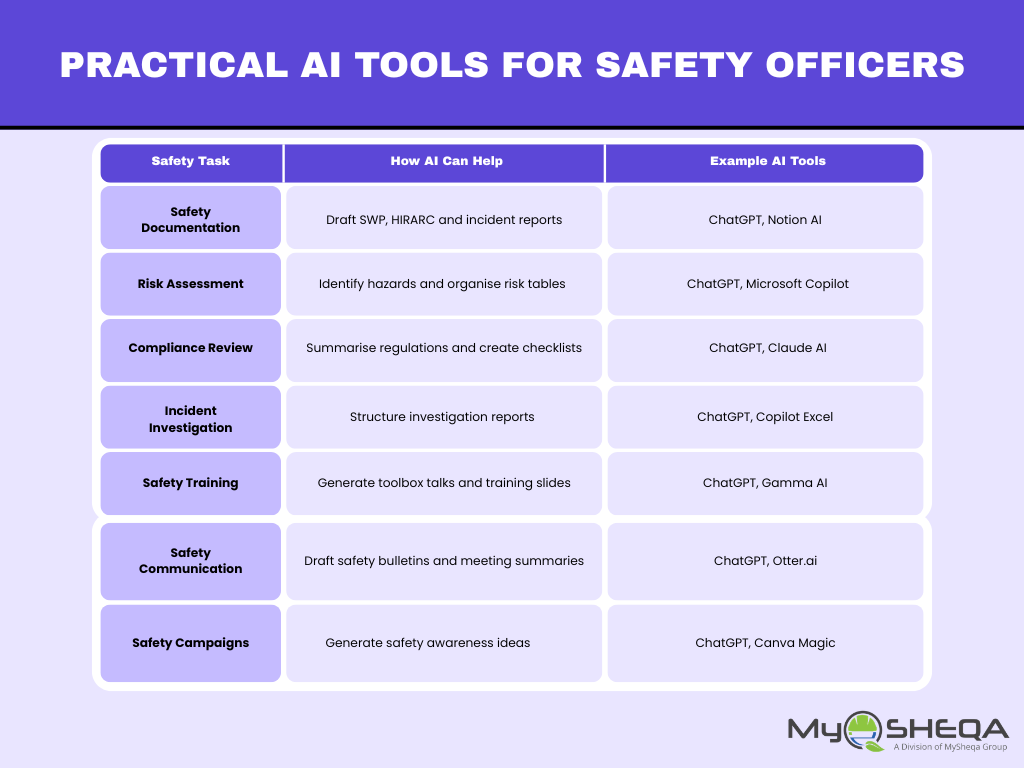
As an example, a safety officer preparing a HIRARC for maintenance work can prompt an AI tool to generate a structured risk assessment table that includes hazards, risk ratings, and suggested control measures. The practitioner can then review and refine the draft to ensure it reflects the actual workplace conditions. Tools that readers can try are ChatGPT and Notion AI.

Supporting Risk Assessment and Hazard Identification
Risk assessment is a fundamental component of workplace safety management. Safety practitioners are responsible for identifying hazards, evaluating risks, and recommending appropriate control measures to protect workers. Conducting thorough risk assessments requires careful analysis of work activities, equipment, environmental conditions, and potential human factors.
AI tools can support AI for Safety Practitioners by helping safety officers explore possible hazards that may be associated with a particular task or work process. AI can also assist in organising risk assessment information into structured formats, which helps ensure that risk evaluations are documented clearly and consistently.
When assessing risks for a new chemical handling task, a safety officer may use AI to brainstorm potential hazards such as chemical exposure, storage risks, spill incidents, or ventilation issues before conducting the formal HIRARC assessment with tools such as ChatGPT and Microsoft Copilot.
Simplifying Safety Regulations and Compliance

Safety officers frequently need to interpret complex safety regulations, industry standards, and compliance requirements. Regulations may include occupational safety legislation, environmental guidelines, and company-specific policies. Understanding these requirements and translating them into practical workplace procedures can sometimes be challenging.
AI can support AI for Workplace Safety Management by helping safety practitioners quickly review lengthy regulatory documents and identify key compliance requirements. This can improve the efficiency of regulatory analysis and assist in developing internal safety checklists or compliance procedures.
In the current workplace, a safety practitioner reviewing new workplace safety regulations may use AI to summarise key legal requirements and convert them into a practical inspection checklist for internal safety audits. This can be achieved through AI tools such as ChatGPT and Claude AI.
Improving Incident Investigation and Root Cause Analysis
Incident investigations are an essential part of maintaining effective workplace safety management systems. After a workplace accident or near miss occurs, safety practitioners must analyse the event, identify underlying causes, and recommend corrective actions to prevent recurrence.
AI tools can support AI for Safety Officers by helping organise investigation findings into clear report structures. They may also assist safety practitioners in analysing patterns within incident data, which can help identify recurring risks or systemic issues within the workplace.
After a minor workplace injury, a safety officer may use AI to organise investigation findings into sections such as incident description, immediate causes, root causes, and recommended corrective actions using tools such as ChatGPT and Microsoft Copilot (Excel).
Creating Safety Training Materials More Efficiently
Safety training plays an important role in building a strong safety culture. Safety practitioners are often responsible for preparing toolbox talks, safety briefings, induction materials, and awareness training for employees. Preparing engaging and informative training content can require considerable time and effort.
By using AI for Safety Practitioners, safety officers can develop training materials more efficiently. AI tools can help generate training outlines, discussion points, and visual presentation content that supports safety awareness initiatives.
A safety officer preparing a toolbox talk on manual handling may use AI to generate discussion topics, example scenarios, and key safety reminders that can guide the training session. They can make it simpler for themselves through the use of AI tools, for example, ChatGPT and Gamma AI.
Enhancing Safety Communication and Reporting
Clear communication is essential for effective Workplace Safety Management. Safety officers frequently prepare reports for management, distribute safety updates to employees, and document safety committee meetings.
AI tools can assist safety practitioners by helping draft safety communications, summarise meeting discussions, and organise safety information in a structured format. This allows safety officers to communicate key safety messages more clearly and consistently within the organisation.
Following a safety committee meeting, a safety practitioner may use AI to summarise the discussion points and produce a short report outlining action items and responsibilities with ChatGPT and Otter.ai.
Supporting Continuous Safety Improvement
Continuous improvement is an important principle in safety management systems. Safety practitioners often develop safety campaigns, workplace awareness initiatives, and improvement programs aimed at reducing risks and strengthening safety culture.
Using AI for Workplace Safety Management, safety officers can generate ideas for workplace safety campaigns, engagement activities, and awareness programmes that encourage employees to adopt safer work practices.
A safety officer planning a workplace safety awareness week may use AI to generate campaign themes, safety slogans, and engagement activities that can help increase employee participation. They will use AI tools such as ChatGPT or Canva Magic Design.

Summary of Practical AI Tools for Safety Officers
To better understand how AI for Workplace Safety Management can be applied in practice, the table below summarises common safety tasks where AI tools can support safety practitioners.
A REMINDER FOR SAFETY PRACTITIONERS USING AI

While AI offers many opportunities to improve productivity, it is important to remember that AI is ultimately just a tool. It can assist in generating ideas, drafting documents, and organising information, but it cannot replace professional judgement, experience, or regulatory accountability.
Safety practitioners must continue to exercise proper due diligence when performing their responsibilities. Any information generated using AI for Safety Officers or AI for Safety Practitioners should always be reviewed, verified, and adapted to ensure it aligns with workplace conditions, organisational procedures, and legal safety requirements.